See How Sales Hiring Increases Runway
Model different hire scenarios before you commit
See runway impact for each rep
Get our Sales Hire Calculator template to reuse
15-day free trial. No credit card required.
"It gives me the clarity to know exactly what levers to pull in order to get the results that we want"

Ryan Pickering
CEO, TruWill
"It gives me the clarity to know exactly what levers to pull in order to get the results that we want"
Ryan Pickering
CEO, TruWill













How Sales Hires Can Extend Runway
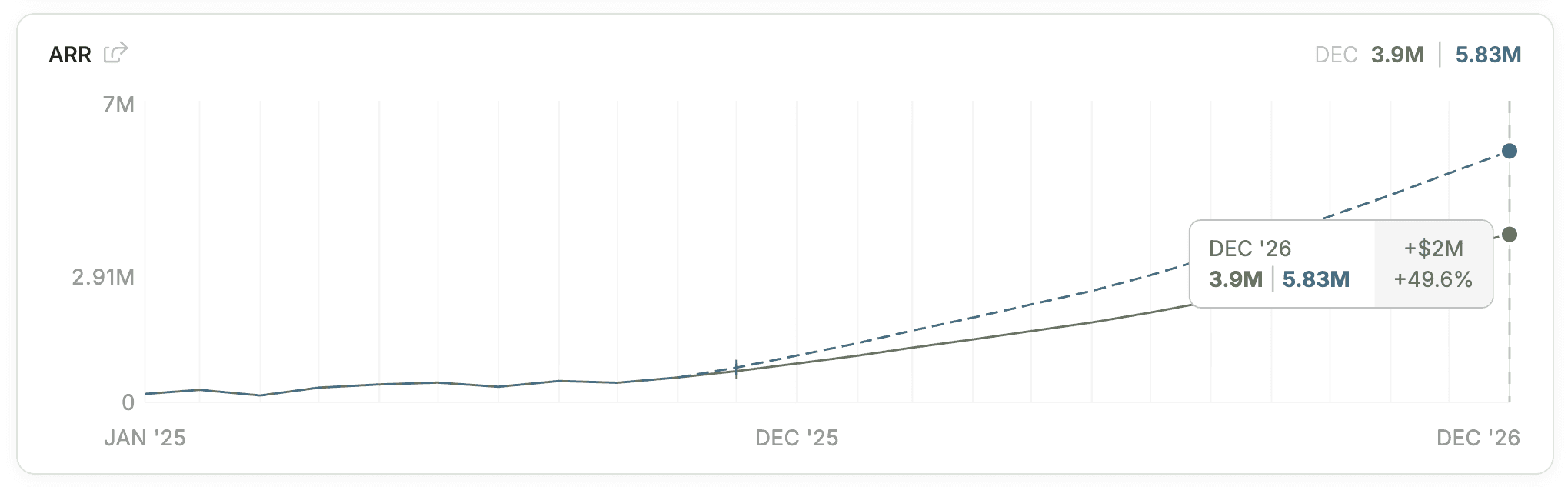
Hiring salespeople often feels like a risk. New salaries, commissions, and ramp time can make it seem like every hire shortens your runway. But when done strategically, sales hires can actually extend it, driving more revenue than they cost.
The key is timing and modeling. A great sales hire is a multiplier rather than expense. If an Account Executive generates $500K in ARR and costs $160K fully loaded, you’re earning a 3x return. That extra ARR funds your operations and gives you more time to reach profitability.
The key is timing and modeling. A great sales hire is a multiplier rather than expense. If an Account Executive generates $500K in ARR and costs $160K fully loaded, you’re earning a 3x return. That extra ARR funds your operations and gives you more time to reach profitability.
The challenge for most founders is knowing when to hire and how to measure the impact. Hire too early, and you’ll burn cash without results. Hire too late, and you’ll miss growth opportunities. The answer lies in modeling:
- New ARR per rep – How much can each salesperson realistically close?
- Ramp time – How long before they’re productive?
- Expense impact – What’s the full cost, including support roles?
By connecting these factors, you can see how each hire affects revenue, expenses, and runway before making the decision.
Frequently Asked Questions
How do I calculate runway?
A basic runway calculation divides your current cash by your monthly burn rate—for example, $500k in the bank and $50k in monthly burn equals 10 months of runway. This method does oversimplify the data. Parallel goes beyond static math by factoring in actual expenses, planned hires, changing revenue, one-time costs, and payment timing to project your real cash runway. It acts as a live, dynamic calculator that updates automatically, helping you understand not just how long your cash will last, but how key decisions impact your financial future.
What’s the difference between accounting and forecasting?
Accounting tracks what already happened—how much you spent, earned, and where the money went. Forecasting maps out what’s coming next based on your plans for growth, spending, and hiring. Parallel connects the two by pulling in your actuals and projecting what’s ahead, so you can make smarter decisions with a clearer view of the future.
Do I need a finance background to use Parallel?
No, many early-stage companies manage finances in Parallel on their own before they hire a CFO. Parallel is built for exactly this scenario. It gives you CFO-level clarity and insights without the full-time CFO cost. You’ll get guided financial planning, scenario analysis, and real-time metrics that help you make informed decisions. This means you can delay hiring a finance person until you’re bigger, while still staying on top of your numbers.
Why shouldn’t I just use spreadsheets for my startup’s finances?
Spreadsheets can certainly work at first, but they often become fragile and time-consuming as your business grows. Startups commonly say “I have a spreadsheet, but I don’t trust it” – manual sheets are prone to errors and constantly need updates. Parallel takes away that headache. It automatically updates your data (no more version control nightmares), ensures consistency, and provides clear dashboards. In short, it gives you financial clarity without the typical spreadsheet chaos, so you’re not second-guessing your model every time something changes.
How quickly can I set up Parallel for my startup?
Very quickly – you can go from sign-up to seeing insights in just a few hours. Parallel is designed to be simple to use with minimal setup. You connect your accounting data (like QuickBooks) and input a few basics about your finances, and Parallel does the rest. There’s no steep learning curve or complicated configuration – even without a finance background, you can have your forecast up and running the same day, and it requires little upkeep to stay accurate.
How does Parallel connect to my accounting software?
Parallel integrates directly with QuickBooks and Puzzle, with other integrations in the works. Once connected, your actuals flow in automatically — keeping your forecast fresh without any manual data entry. Setup takes about 15 minutes.
How is Parallel different from other forecasting tools?
Most forecasting tools are built for finance teams. Parallel is built for founders. That means it’s simpler to set up, easier to understand, and always connected to your real numbers. You don’t need a CFO or a finance background to model your runway, plan hires, or prep for a raise.