Table of Contents
Introduction
Readiness Assessment: Are You Ready to Hire Your First AE?
Understanding AE Ramp Time and Its Financial Impact
Compensation Planning: Budgeting for Your First AE
Runway Impact Modeling: The True Cash Cost of Your First AE
Scenario Planning: Testing Hiring Decisions Against Runway
Making the Hire/No-Hire Decision
Key Takeaways
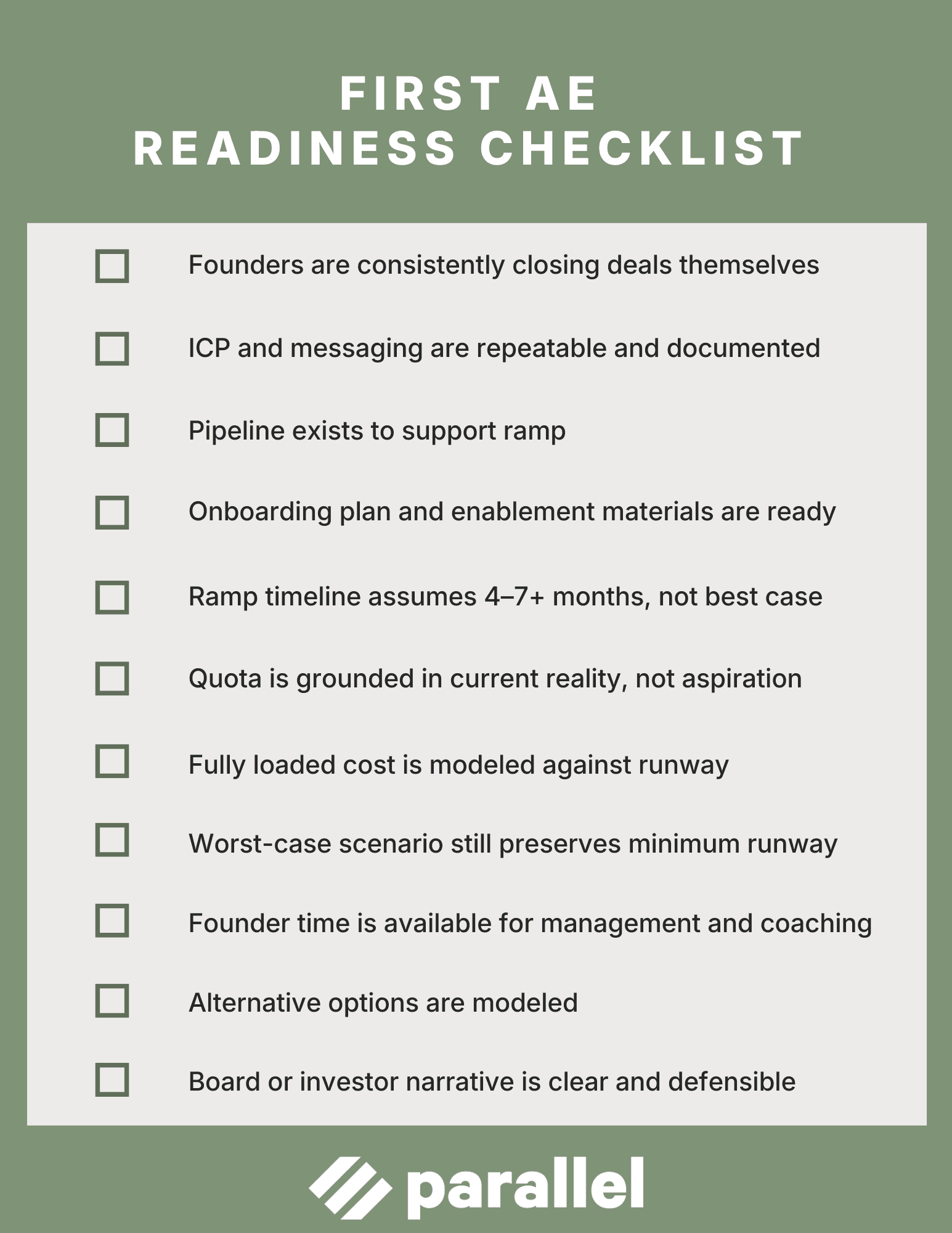
When To Hire Checklist
When To Hire Your First AE
You've closed a few deals, your calendar is packed with demos, and your co-founder just asked: "Should we hire an AE?" The question feels urgent. But hire too early and you'll burn through runway before they close a single deal. Wait too long and you'll become the bottleneck that stalls growth.
The answer isn't about hitting a magic ARR number. It's about understanding the financial reality of bringing on a full-time seller: the 5-7 month ramp period, the fully-loaded cost that's 3x their base salary, and the runway impact that could shrink your 18-month cushion to 14 months before they generate a dollar of revenue.
This guide walks through the readiness checklist, compensation benchmarks, and scenario modeling you need to make this decision with confidence instead of hope.
Readiness Assessment: Are You Ready to Hire Your First AE?
Pre-Hire Checklist
Three conditions need to be true before you start recruiting. First, you need product-market fit. Even an excellent salesperson won't make an impact if you haven't proven people will pay for your product. Second, you need a repeatable sales motion with documented assets, talk tracks, and a clear path from lead to close. Third, you need a proven ICP with consistent deal velocity showing that your wins aren't random.
When you're the bottleneck creating delays for prospects ready to buy, that's a signal. When you're turning down qualified meetings because your calendar can't absorb more, that's another. But if you're still figuring out messaging or your close rate varies wildly by prospect type, you're setting a new hire up to fail.
ARR and ACV Thresholds
Above $1M ARR, companies begin to need a full-time AE dedicated to managing pipeline. Below that threshold, founders typically handle closing while SDRs or BDRs generate leads. The economics matter: if your ACV is at least $5K-$10K, you can justify the cost of an AE. Anything lower requires careful hiring for low-ACV environments where volume and efficiency become critical.
These aren't arbitrary milestones. They reflect the payback math: an AE earning $100K in OTE needs to close $400K-$500K annually to justify their cost. If your average deal is $3K, they need to close 133+ deals per year, which changes the skill profile and support structure required.
Founder Bottleneck Test
Your calendar tells the truth. If qualified prospects are waiting weeks for a discovery call, or you're declining meetings because you're maxed out, you've hit capacity. Your own calendar bursting at the seams with qualified sales meetings is one of the clearest readiness signals.
But bottleneck doesn't just mean busy. It means you have more qualified pipeline than you can handle, not just more meetings. If your problem is lead quality or conversion rates, an AE won't solve it.
Understanding AE Ramp Time and Its Financial Impact
Realistic Ramp Timeline Expectations
The average new sales hire is fully productive 5.3 months after their start date. For simple products with short sales cycles, ramp time can compress to a few weeks. For complex B2B products with 90+ day sales cycles, AEs can take over a year to completely ramp up.
The ramp period isn't just onboarding. It includes learning your product, understanding your ICP, building pipeline, and working deals through your full sales cycle. Top-performing Account Executives require an average of 5.7 months to reach quota, completing over 7,000 activities to close their first deal.
Ramp Time Calculation Formula
The most common formula is your average sales cycle length plus 90 days for onboarding and training. If your sales cycle is 60 days, plan for a 5-month ramp. If it's 120 days, you're looking at 7 months before they're closing consistently.
This calculation matters for cash planning. A 6-month ramp means six months of salary, benefits, and support costs before revenue contribution begins. That's $50K-$60K in cash out the door for an entry-level AE before they close their first deal.
How Ramp Time Affects Hiring Timeline
Start recruiting 3-4 months before hitting $1M ARR because finding the right person takes longer than expected, and they need training to hit effectiveness when business accelerates. If you wait until you're at capacity, you'll be 6-9 months late to the revenue impact you need.
Backward planning is critical. If you need an AE producing in Q3, you need to start recruiting in Q4 of the previous year. If you haven't considered ramp-up time, you will invariably miss your ARR target.
Calculating the True Cost of Ramp
The cost of ramping a new sales rep is estimated to be three times their base salary, factoring in training, lost productivity, and opportunity cost. For an AE with a $70K base, you're investing $210K before they reach full productivity.
This includes direct costs like salary and benefits, but also indirect costs: your time training them, deals that move slower during ramp, and the pipeline they should be building but aren't yet. The longer the ramp, the higher the multiplier.
Compensation Planning: Budgeting for Your First AE
Base Salary and OTE Benchmarks by Stage
Entry-level AEs at small SaaS startups typically earn $60K-$100K base with total compensation between $120K-$200K depending on geography and stage. In hub cities like New York or San Francisco, expect $75K-$100K base and $150K-$200K OTE. In Mountain or Central time zones, ranges drop to $60K-$90K base with $120K-$180K total.
The average base salary across all AEs is $100K with $190K OTE, but early-stage startups typically pay below market to balance cash preservation with equity upside. Your first AE should understand they're trading lower cash comp for equity and the chance to build something from scratch.
Quota-to-OTE Ratio Standards
The median quota-to-OTE ratio in 2024 is 4.2x, with typical ratios ranging from 3.2x to 4.8x. For every $100K in OTE, quota typically ranges between $320K and $480K. An AE earning $120K OTE should carry a $400K-$500K annual quota.
These ratios reflect payback economics. If an AE costs $120K fully loaded and generates $400K in new ARR, you're looking at a 3.3x return before factoring in gross margin. In early days of a sales team, ratios can be lower (2x-6x) as you're still proving the sales motion.
Pay Mix and Commission Structure
The typical pay mix for an AE is 50:50: base salary around 50% of OTE, with variable pay including commissions and bonuses making up the other 50%. This structure creates alignment around quarterly bookings goals. If a salesperson doesn't perform, they don't get paid, which protects your cash while incentivizing results.
Commission structures vary, but most startups use monthly or quarterly accelerators that reward over-quota performance. A simple structure: 100% of variable for hitting quota, 150% for exceeding it. Keep it simple for your first hire.
Runway Impact Modeling: The True Cash Cost of Your First AE
Total Hiring Cost Components
The fully-loaded cost includes base salary, payroll taxes (7.65% FICA), benefits (health insurance, 401k), recruiting fees (15-25% of base if using an agency), equipment ($2K-$3K for laptop and software), and training materials. For most startups, salaries and benefits are the single biggest expense.
For an AE with $80K base and $80K variable, expect $100K-$110K in year-one cash cost when they're ramping and not earning full commission. Add another $10K-$15K for recruiting, equipment, and tools. Total first-year cash outlay: $110K-$125K.
Payback Period Calculations
With monthly payment terms, the fundamental sales unit repays itself in five months. With annual prepay, breakeven drops to three months, which is why startups with annual contracts can hire salespeople more aggressively.
For B2B businesses selling to SMBs, less than 6 months CAC payback is great, 12 months is good, 18 months is acceptable. For enterprise, those numbers extend to 12, 18, and 24 months respectively. Your payment terms dramatically affect how quickly a new AE becomes cash-positive.
Monthly Burn Rate Impact
Hiring an AE immediately increases monthly burn by $8K-$10K (base salary plus benefits and taxes). During the 5-7 month ramp period, that's $40K-$70K in cash out with zero revenue contribution. Every hire adds to burn rate through salary, payroll taxes, healthcare, and other benefits.
If your current monthly burn is $50K, adding an AE increases it to $58K-$60K. That's a 16-20% increase in burn before any revenue offset.
Runway Before and After Scenarios
Example: You have $900K in the bank and $50K monthly burn, giving you 18 months of runway. You hire an AE at $80K base ($8.5K monthly fully loaded). Your new burn is $58.5K, and your runway drops to 15.4 months. But that assumes zero revenue contribution.
More realistic scenario: 6-month ramp, then $30K MRR contribution starting month 7. First six months: runway drops from 18 to 15.4 months. Months 7-12: net burn drops to $28.5K, extending runway. The crossover point matters: when does the AE's contribution offset their cost?
Scenario Planning: Testing Hiring Decisions Against Runway
Building Your Hiring Scenario Model
Key variables to model include: hire date, ramp duration (conservative vs. optimistic), quota attainment curve (0% month 1, ramping to 100% by month 6), pipeline conversion rates, and payment terms. Parallel's forecasting model lets you adjust these assumptions in real-time and instantly see the runway impact.
Your model should account for the J-curve effect: burn increases immediately while revenue lags by 6-9 months. The trough of that J-curve is where runway risk peaks.
Three Scenarios to Test
Compare three paths: hire a full-time AE now, delay hiring 6 months while you continue founder-led sales, or bring in fractional AE support as a bridge. Scenario analysis creates multiple financial projections based on different assumptions, helping you identify risks and evaluate impact before committing.
Each scenario should model monthly burn, runway, ARR growth, and founder capacity. The right choice depends on your current runway, pipeline coverage, and growth targets.
Scenario 1: Hire Full-Time AE Now
Immediate impact: burn increases by $8K-$10K monthly. Months 1-6: pure cash outflow with no revenue contribution. Month 7+: AE begins closing deals, contributing $20K-$40K MRR by month 9 if ramping well.
This scenario makes sense when you have 15+ months of runway, strong pipeline coverage, and founder capacity is the clear bottleneck. The upside is accelerated pipeline building that pays off in quarters 3-4.
Scenario 2: Delay Hiring 6 Months
Runway impact: you preserve $50K-$60K in cash over six months. Revenue impact: you miss the pipeline building that would have happened during the AE's ramp, pushing revenue acceleration out by 6-9 months.
The opportunity cost of founder-led sales bottleneck is real. If you're turning down qualified meetings or deals are slipping because you're maxed out, delaying costs you more in lost revenue than you save in cash.
Scenario 3: Fractional AE Support
Fractional AEs typically cost $6K-$15K monthly, roughly 60-75% of a full-time hire's cash cost. You get experienced sales capacity without the long-term commitment or full ramp investment.
This works as a bridge when runway is 10-14 months and you need sales capacity but can't absorb the risk of a full-time hire. The flexibility lets you test sales scalability before committing to headcount.
Using Financial Planning Tools for Hire Timing
Parallel's scenario modeling lets you test different hiring timelines against your actual burn rate and runway. Adjust the hire date, ramp assumptions, and quota attainment curve to see exactly how each decision affects your cash position month by month.
The model shows you the crossover point where the AE becomes cash-positive, the maximum runway drawdown during ramp, and the ARR impact by quarter. Dynamic models let you answer hard questions before they become hard consequences.
Making the Hire/No-Hire Decision
Green Light Indicators
Hire when you have 15+ months of runway post-hire, a documented ICP with consistent win rates, and 3+ months of qualified pipeline coverage. Companies with structured scenario planning achieve 25-70% higher ROI because they're making decisions with data instead of intuition.
Other signals: founder calendar is saturated with qualified meetings, you're turning down opportunities, and your close rate is consistent across similar prospect profiles. These indicate a proven sales motion ready to scale.
Red Flags to Pause
Don't hire with less than 12 months of runway unless you have a clear path to extend it. If runway drops below six months, immediate action is required. Other red flags: unproven sales process, inconsistent messaging, or ICP that's still evolving.
If you make a bad hire for your first or second salesperson, it can kill the company. The cost isn't just the salary; it's the 6-9 months of runway burned while you figure out it's not working.
Key Takeaways
Complete the readiness checklist first: product-market fit, repeatable sales motion, documented ICP, and founder capacity as the clear bottleneck
Model the true cost: 5-7 month ramp period, 3x base salary total investment, and $8K-$10K monthly burn increase before revenue contribution
Use scenario planning to test options: compare hire-now vs. delay vs. fractional approaches against your actual runway and growth targets
Leverage financial planning tools: Parallel's forecasting model lets you adjust hire dates and ramp assumptions to see exactly how each path affects your cash position and ARR trajectory
Maintain 15+ months of runway: this absorbs the 6-month ramp period and provides a performance evaluation window without jeopardizing your next fundraise
The decision isn't about hitting $1M ARR: it's about having sufficient runway, a proven sales motion, and the financial clarity to absorb a multi-month ramp period
When To Hire Checklist